
One of the things I love about travel is that it changes the way you experience history.
At home, history often feels like something you learned in school, memorized for a test, and then filed away somewhere in the back of your mind.
When you’re standing where it happened, though, it feels different.
When we did our walking tour of Porto, our guide told us about the Carnation Revolution of April 25, 1974. Before coming to Portugal, I knew nothing about it. I certainly didn’t know that Portugal went from being a democratic republic to living under an authoritarian government known as the Estado Novo for a period of nearly 50 years.
Our guide painted a picture of what life was like then: Political dissent carried consequences. Political opponents were jailed. Traditional Catholic values were tied to Portuguese nationality. The press was censored. Political police roamed the streets, maintaining a pervasive network of surveillance and censorship, effectively destroying all organized domestic opposition and stifling fundamental civil liberties. They utilized systemic violence to exercise broad control over public life and held thousands of citizens for long periods in political prisons without formal charges or due process.
They also completely eliminated democratic voting, replacing it with a heavily manipulated electoral system designed solely to legitimize the dictatorship. The regime restricted suffrage using strict tests and property requirements to disenfranchise the poor and women. The political police intimidated voters and blocked independent observers from watching the ballot boxes.
Then, in one extraordinary day, everything changed.
The Spark: The rebellion kicked off in the early hours of April 25, 1974, when rebel troops seized control of Lisbon’s commercial radio stations. They broadcasted two specific songs, E Depois do Adeus and Grândola, Vila Morena, which served as coordinated signals for military units across the country to mobilize and occupy strategic locations. This was the part of our tour guide’s story that gave us goosebumps.
The Regime Falls: Marcello Caetano was forced to surrender within 24 hours. He and other regime leaders were arrested and later sent into exile.
Decolonization & Democracy: The revolution brought a swift end to the colonial wars and led to the independence of Portugal’s African territories, including Angola, Mozambique, and Guinea-Bissau. In Portugal, it dismantled the political police and successfully paved the way for civil liberties, free elections, and a new constitution.
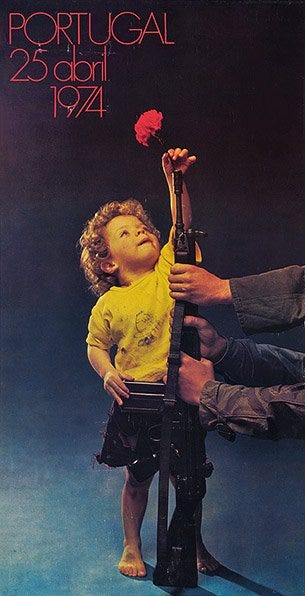
The Flowers: As soldiers moved through Lisbon to take back the government for the people, civilians began placing red carnations into the barrels of their rifles. Instead of becoming symbols of violence, the rifles became symbols of hope. The image is so simple that it almost seems impossible, yet it has become one of the defining moments in modern Portuguese history.
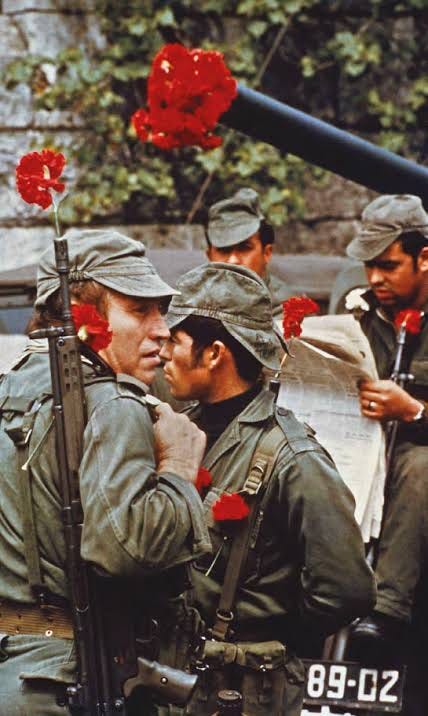
This was not just another historical event here. It’s woven into the country’s identity because it represents something larger than a change in government. It represents the moment people regained the freedom to speak openly, to vote meaningfully, to practice their chosen religion (or none at all) with separation of church and state, and to shape their own future.
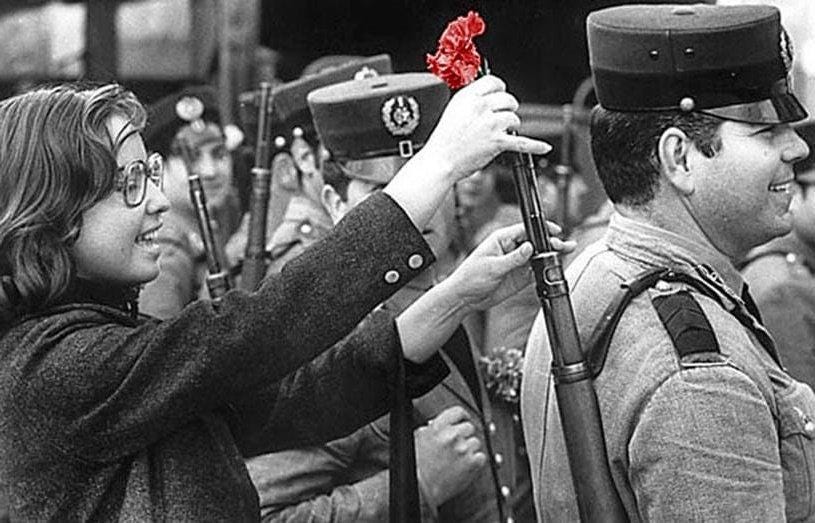
One of the unexpected gifts of travel is perspective.
You realize that freedoms you barely notice are extraordinary in many parts of the world, and were hard-won in places that now seem peaceful and secure.
And that Democracy isn’t self-sustaining.
Like a garden, it requires tending, patience, and the willingness of ordinary people to care for something that may never seem urgent, until one day it is.
Portugal reminds visitors of that every April with carnations instead of military parades.
I find something profoundly hopeful about that.
The symbol of their revolution wasn’t a weapon.
It was a flower.
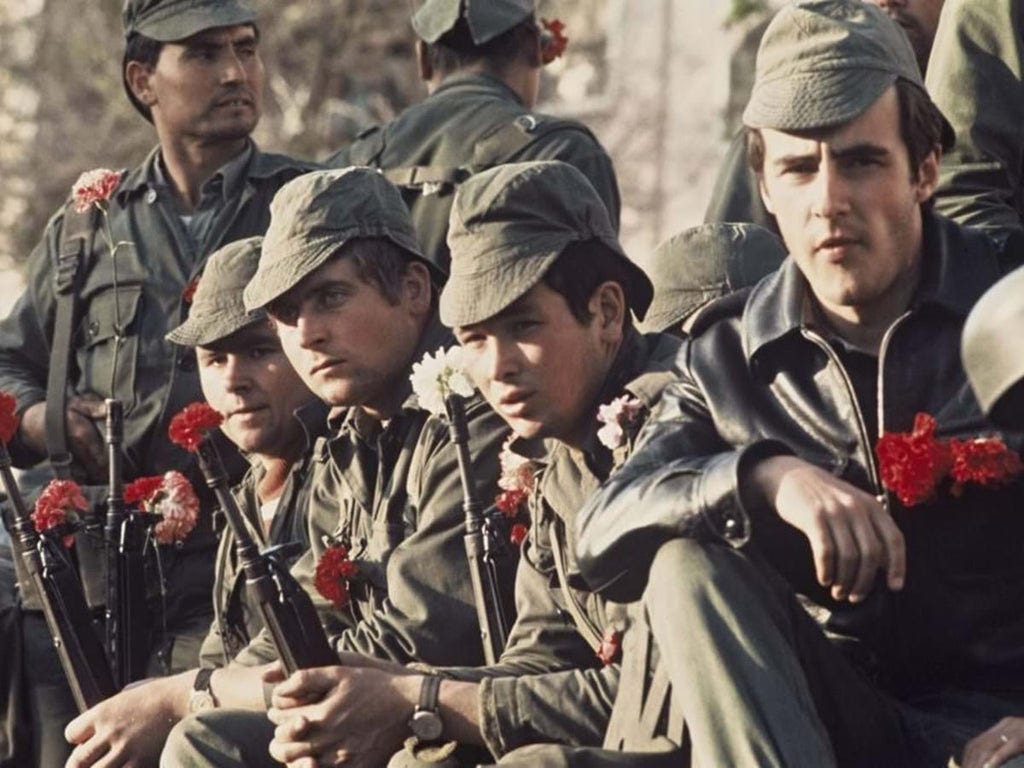
Today, April 25 is celebrated as “Freedom Day” (Dia da Liberdade) in Portugal and remains an important national holiday honoring the restoration of democracy.
Beautifully written! I really look forward to the sharing of your adventures and knowledge❣️
Beautiful